

Aerospace Connectors: Connecting the Skies With Reliability
Aerospace connectors, also known as avionics connectors, are specialized components utilized to connect electrical systems in aircraft. They are designed to withstand extreme environmental conditions, including high altitudes, temperature variations, and vibration. These connectors ensure reliable communication and power transmission between different onboard systems, such as navigation and control systems.
In this article, we will look at the types of avionics connectors, their applications, and their role in the demanding aerospace environment.
Roles of Connectors in the Aerospace Sector
Below are the different roles of connectors, each playing a vital part in ensuring the reliability and safety of aircraft systems:
Power Distribution
Connectors are crucial in power distribution within aircraft by ensuring that electrical power is delivered reliably to several systems. They connect power sources — such as generators or batteries — to critical systems, including avionics, lighting, and propulsion.
Data Transmission
High-speed and reliable data connectors are vital for maintaining the integrity and performance of aerospace systems. They ensure that data is transmitted with minimal loss and interference, essential for accurate navigation and effective aircraft control.
Signal Routing
Aerospace connectors route different signals, including control signals, sensor inputs, and feedback. They are vital for connecting sensors to data acquisition systems and control units, enabling the aircraft to respond accurately to operational commands.
Communication Systems
Robust connectors are essential for maintaining effective communication channels and ensuring safety and coordination. These components guarantee reliable and clear communication between the aircraft, ground control, and crew members.
Avionics Integration
Connectors support the integration of several avionics systems, enabling different components to work together. They also connect flight management systems, autopilots, and display panels, which allow for integrated operation and management of the aircraft’s avionics suite.
Maintenance and Upgrades
Different aerospace connectors facilitate the maintenance and upgrading of aerospace systems by enabling modular and easily replaceable connections. This modularity allows for quick repairs and replacements, minimizing downtime and maintaining the aircraft’s operational readiness.
Types of Aerospace Connectors and Their Applications
The following types of connectors contribute to the reliability and functionality of aerospace systems:
Circular Connectors
Circular connectors are widely used in aerospace applications due to their robust design and ease of use. They are cylindrical and can have multiple pins for connecting different electrical signals. These components are commonly used in avionics, control systems, and power distribution because they provide secure connections in harsh environments.
Rectangular Connectors
Rectangular connectors are designed to accommodate a high density of contacts in a compact space. They are mostly used in applications where space is limited and many connections are required. They are commonly found in cockpit displays, communication systems, and flight control units due to their reliability and space efficiency.
Radio Frequency (RF) Connectors
RF connectors are essential in aerospace applications for communication systems, radar, and navigation equipment. They are engineered to minimize signal loss and interference, ensuring clear and dependable communication. They come in several types — such as SMA, BNC, and TNC — each suitable for different frequency ranges and applications.
Fiber Optic Connectors
Fiber optic connectors are used in aerospace applications due to their ability to handle large amounts of data and their resistance to electromagnetic interference. They are commonly employed in data networks, in-flight entertainment, and advanced communication systems. These components also provide high bandwidth and are ideal for long-distance signal transmission in aircraft.
D-Sub Connectors
D-Sub connectors are known for their unique D-shaped metal shield, which provides mechanical stability and reduces electromagnetic interference. These components are utilized in avionics and other systems for data transmission and control signals. They also come in different sizes and pin configurations, making them versatile for aerospace applications.
Discover Reliable Solutions With Connectronics Today!
Connectronics stands at the forefront of aerospace connectivity, offering innovative solutions that ensure reliability, performance, and safety for your critical systems. Our connectors are engineered to meet the highest standards, which provide you with the peace of mind needed for seamless operations.
Contact us to learn how our cutting-edge technology can elevate your aerospace systems and drive your success! You can also request a quote to get started.
The Essential Guide to High-Voltage Electrical Connectors
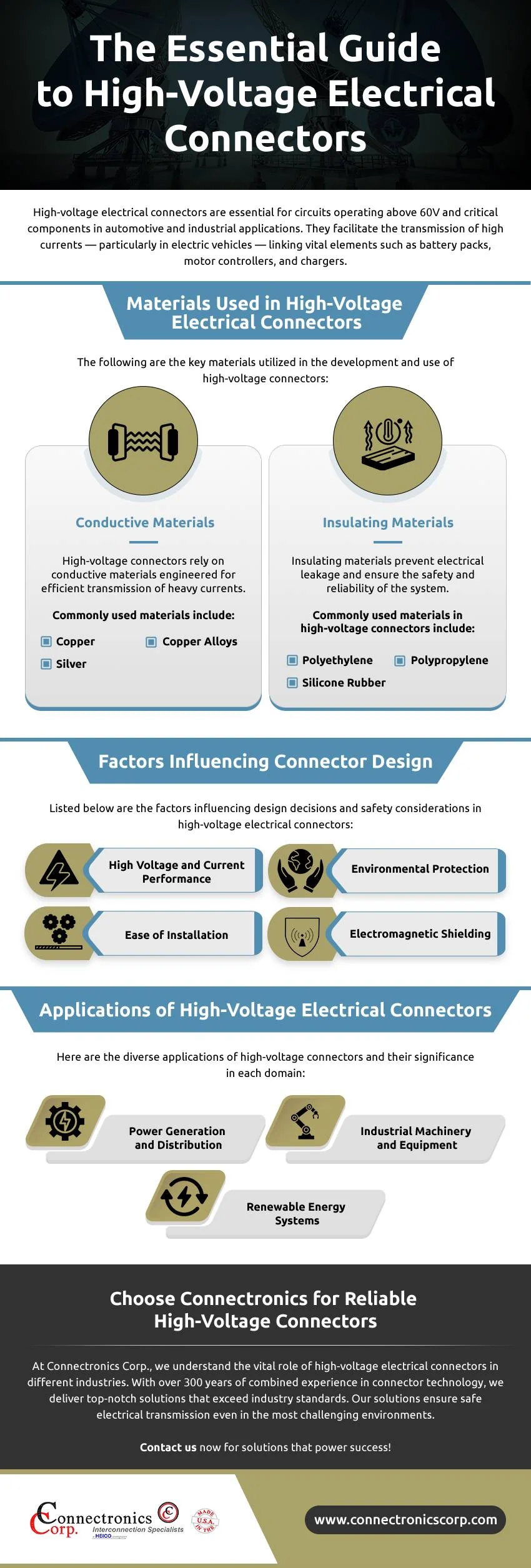
High-voltage electrical connectors are essential for circuits operating above 60V and critical components in automotive and industrial applications. They facilitate the transmission of high currents — particularly in electric vehicles — linking vital elements such as battery packs, motor controllers, and chargers.
This article explores the crucial role of high-voltage electrical connectors in diverse industries. We will delve into their applications, materials, and safety considerations, particularly in high-power environments.
Materials Used in High-Voltage Electrical Connectors
The following are the key materials utilized in the development and use of high-voltage connectors:
Conductive Materials
High-voltage connectors rely on conductive materials engineered for efficient transmission of heavy currents. Commonly used materials include:
- Copper: This is known for its excellent conductivity and mechanical properties, carrying heavy currents effectively.
- Copper alloys: Various copper alloys, such as brass and bronze, are utilized in high-voltage electrical connectors to enhance specific properties such as strength, corrosion resistance, and conductivity.
- Silver: This boasts superior conductivity compared to copper and is sometimes used in specialized high-performance connectors where maximum conductivity is required.
Insulating Materials
Insulating materials prevent electrical leakage and ensure the safety and reliability of the system. Commonly used materials in high-voltage connectors include:
- Polyethylene: This is known for its excellent dielectric properties and mechanical resilience.
- Polypropylene: Similar to polyethylene, polypropylene offers good dielectric properties and mechanical strength.
- Silicone rubber: This is highly valued for its flexibility, thermal stability, and resistance to environmental factors.
Factors Influencing Connector Design
Listed below are the factors influencing design decisions and safety considerations in high-voltage electrical connectors:
High Voltage and Current Performance
High-voltage connectors must be designed to handle the elevated voltage and current levels present in high-power environments. This involves selecting materials and configurations that efficiently conduct electricity while minimizing resistance and heat generation. Connectors must also maintain stable electrical properties at high voltages and currents to ensure reliable performance and safety.
Environmental Protection
Electrical connectors often face harsh environmental conditions, including high temperatures, vibrations, impacts, dust, and water exposure. Design decisions must prioritize integrating protective measures to ensure the connectors withstand such conditions without degradation. Environmental protection guarantees connectors remain undamaged and reliable in tough situations.
Ease of Installation
High-voltage connectors should be designed for easy installation to minimize downtime and ensure efficient system integration. This involves connector form factor, mounting options, and connector interface compatibility. Connectors should feature intuitive designs and standardized connection methods to simplify installation and minimize installation errors.
Electromagnetic Shielding
These connectors should possess effective shielding capabilities to prevent electromagnetic interference (EMI) and ensure signal integrity in sensitive electronic environments. This includes using shielding materials and designs to reduce electromagnetic emissions and prevent external interference. Effective electromagnetic shielding maintains signal quality in noisy environments.
Applications of High-Voltage Electrical Connectors
Here are the diverse applications of high-voltage connectors and their significance in each domain:
Power Generation and Distribution
High-voltage connectors are instrumental in power generation and distribution, ensuring reliable long-distance electricity transmission. They interconnect high-voltage cables, transformers, and other electrical components in power plants and substations. These connections maintain the efficiency of the electrical network from power stations to end-users.
Industrial Machinery and Equipment
In industrial settings, high-voltage connectors are vital for powering heavy machinery and equipment. They facilitate the safe transmission of electricity to motors, actuators, and control systems. Manufacturing, mining, and transportation industries rely on these connectors to uphold productivity and improve tasks such as powering conveyor belts and operating cranes.
Renewable Energy Systems
These connectors facilitate renewable energy transmission to the grid by interconnecting solar panels, wind turbines, and other components that ensure efficient energy conversion and distribution. As the demand for clean energy increases, high-voltage connectors will continue to support the transition to renewable sources.
Choose Connectronics for Reliable High-Voltage Connectors
At Connectronics Corp., we understand the vital role of high-voltage electrical connectors in different industries. With over 300 years of combined experience in connector technology, we deliver top-notch solutions that exceed industry standards. Our solutions ensure safe electrical transmission even in the most challenging environments.
Contact us now for solutions that power success!
Innovations in High-Voltage Connector Technology

A high-voltage connector is designed to safely and reliably transmit electricity in settings with voltages above standard levels. It is engineered to withstand high levels of electrical stress and prevent arcing or insulation breakdown. This makes it suitable for various applications, such as power generation, distribution, transmission, electric vehicle (EV) manufacturing, and industrial machinery.
Over the years, high-voltage connector technology has evolved to meet the increasing demands for safety, efficiency, and reliability in electrical systems. Here are some of the most notable innovations:
1. Compactness and Miniaturization
Engineers strive to reduce the size and weight of a high-voltage connector while maintaining or even improving its performance characteristics. This innovation is particularly crucial in applications where space is limited, such as in EVs and portable electronic devices. A compact connector can also improve system efficiency by minimizing energy losses and optimizing space utilization.
2. Cybersecurity Features
With the rising digitalization of power systems and the advent of smart grid technologies, cybersecurity features are becoming more crucial in high-voltage connections. Connector design innovations include built-in security mechanisms like encryption, authentication, and intrusion detection. They guard against cyber attacks and ensure data integrity in digitalized power networks.
3. Environmental Sustainability
In response to increasing environmental concerns, there is a growing emphasis on developing more environmentally friendly high-voltage connectors. This includes using recyclable materials in the manufacturing process. Manufacturers are also exploring ways to minimize energy consumption during production by implementing energy-efficient methods.
4. High-Frequency Capabilities
With the increasing popularity of high-frequency power transmission systems, there has been a focus on developing high-voltage connectors that can handle such signals. These connectors are engineered to minimize signal losses and electromagnetic interference, ensuring efficient power transfer in applications like renewable energy systems. They are also suitable for telecommunications infrastructure, radar systems, medical equipment, and high-speed data transmission networks.
5. Integration of Smart Features
Modern high-voltage connectors incorporate features that enable real-time monitoring of connector health, temperature, and performance parameters. These allow for predictive maintenance and enhanced reliability. Examples of smart features include the following:
- Communication capabilities: These allow communication interfaces to transmit data to centralized monitoring systems or control rooms.
- Diagnostic systems: These can detect anomalies, predict potential failures, and recommend maintenance actions to prevent downtime and optimize performance.
- Embedded sensors: These continuously monitor environmental conditions and connector performance, providing real-time data for analysis.
- Fault detection and analysis: These can identify the root cause of faults and provide insights into potential corrective actions, helping to prevent costly equipment failures.
- Remote control and management: These allow operators to remotely activate, deactivate, or adjust connector settings as needed, enhancing operational flexibility.
6. Interoperability and Standardization
Standardization efforts within the industry aim to improve interoperability between companies’ connectors and ensure compatibility across various systems and applications. Innovations in connector design and interfaces enable plug-and-play integration, simplifying system design and reducing integration costs for end-users.
7. Modular Designs
Modular high-voltage connectors are intended to adapt to varying voltage levels, current capacity, and environmental conditions. They facilitate installation, maintenance, and upgrades, lowering downtime and costs associated with system changes. Furthermore, these devices improve scalability, which enables users to easily expand or reconfigure their electrical systems as needed.
8. Multi-Contact Systems
Traditional single-point connectors are being replaced by multi-contact systems capable of transmitting multiple signals or power lines through a single connector interface. These connectors offer higher density, reduced footprint, and simplified wiring, making them ideal for applications where space is limited. They also apply in settings where multiple connections must be made efficiently.
Choose Connectronics Corp. for High-Quality Electrical Connectors
At Connectronics Corp., we are committed to providing our valued customers with exceptional quality and dependable electrical connectors! We follow strict quality control measures from initial design concepts to final production. This ensures that our products meet and exceed the most rigorous industry standards.
Contact us or request a quote today!
The Science Behind Hermetically Sealed Connectors
Hermetic connectors are specialized electrical connectors designed to maintain a completely sealed and airtight environment around electrical contacts. This sealing prevents the ingress of gases, liquids, and other contaminants, ensuring the integrity and reliability of electrical connections in harsh or extreme environments. They are typically used in industries where equipment integrity is non-negotiable, including aerospace, military, and medical.
This article delves into the materials, design, and manufacturing processes that make hermetically sealed connectors indispensable in critical applications.
Materials Used in Hermetically Sealed Connectors
The choice of materials is fundamental to the effectiveness of hermetic connectors. Options include:
1. Stainless Steel
Stainless steel is popular for hermetic connectors due to its exceptional corrosion resistance and mechanical strength. It can withstand exposure to moisture, chemicals, and high temperatures without compromising its structural integrity.
2. Titanium
Titanium offers an excellent strength-to-weight ratio and is highly resistant to corrosion. It can also endure extreme temperatures and pressures, making it suitable for applications in aerospace and marine environments.
3. Kovar
Kovar is a nickel-cobalt ferrous alloy prized for its low coefficient of thermal expansion. This makes it compatible with glass-to-metal sealing processes, ensuring a reliable hermetic barrier against moisture and contaminants.
4. Ceramics
Alumina and zirconia ceramics are widely used in hermetically sealed connectors for their excellent insulating properties and resistance to high temperatures. These materials provide electrical insulation between conductive components and can withstand thermal cycling and mechanical stress.
Design Principles of Hermetic Connectors
Designing hermetically sealed connectors focuses on ensuring a perfect seal and reliable electrical performance. Key elements include:
Sealing Mechanism
Hermetic connectors are designed with specialized seals, typically made through glass-to-metal or ceramic-to-metal bonding. This ensures an airtight and watertight seal, preventing the ingress of gases, liquids, and contaminants that could compromise the integrity of the connection.
Contact Configuration
The arrangement of contacts within the connector is meticulously designed to minimize electrical resistance and maximize signal integrity. Whether a single pin or a complex array of contacts, each configuration is engineered to ensure reliable electrical conductivity and minimal signal loss.
Shell Design
The connector’s outer shell is carefully designed to provide mechanical protection and a secure connection. This includes various considerations — such as the shell’s shape, size, and material — and features like locking mechanisms or threaded fittings. The goal is to ensure the connector remains firmly connected, even under intense vibration, shock, or thermal expansion conditions.
Shielding
Many hermetic connectors incorporate shielding to protect against electromagnetic interference (EMI). This is essential in environments where electronic noise can disrupt signal integrity, such as in military communications or sensitive medical equipment.
Environmental Considerations
Hermetically sealed connectors are often deployed in environments characterized by extreme temperatures, pressure, humidity, or exposure to corrosive substances. As such, the design must consider these environmental factors and incorporate features to withstand such conditions without compromising performance.
Key Manufacturing Processes
Manufacturing hermetically sealed connectors involves several meticulous processes to ensure each connector meets stringent quality standards. These include the following:
Machining
Advanced techniques such as computer numerical control (CNC) machining are employed to create metal and ceramic components with tight tolerances and intricate designs. This ensures that each component meets the specifications for perfect fit and optimal performance.
Sealing
This process involves carefully joining the metal and ceramic parts to create a hermetic barrier. Depending on the materials used and the specific design requirements, various sealing techniques may be employed, including glass-to-metal sealing and brazing.
Testing and Quality Assurance
Each connector undergoes rigorous testing to verify its hermeticity, mechanical integrity, and electrical performance. These may include leak detection, thermal cycling, and electrical continuity checks.
Partner With Connectronics for Reliable Connector Solutions!
Connectronics Corp. specializes in designing and manufacturing custom connectors and interconnection systems. With over 300 years of experience, we craft connectors tailored to specific requirements in various sectors, such as avionics, aerospace, medical, nuclear, and more. As an AS9100D with ISO9000-2015 certified company, we ensure consistent products and services that meet and exceed customer expectations.
Request a quote today to learn more about our products and services!
Advancements in Hermetically Sealed Connector Design
Hermetically sealed connectors are critical components designed to ensure gas-tight and liquid-tight connections, which are essential for maintaining system integrity in demanding environments. They are indispensable in industries such as aerospace, defense, and medical devices, where reliable connections are crucial for safety. Recent innovations have focused on improving sealing, reducing connector size, and enhancing material strength — leading to better performance in challenging conditions.
This article explores the latest advancements in hermetically sealed connector design, addressing the needs of industries requiring durable and reliable connections in challenging settings.
1. Miniaturization and High-Density Solutions
As electronic devices become smaller, the demand for miniaturized hermetic connectors with high-density configurations has increased. These connectors save space and reduce weight while maintaining performance, making them ideal for aerospace, medical devices, and military applications. Accommodating many connections in a compact footprint ensures efficient use of limited space without compromising reliability and durability.
2. Advanced Materials and Coatings
Advanced materials such as titanium, ceramic, glass, and specialized coatings enhance corrosion resistance and electrical performance. Superior strength and resistance to harsh environmental factors make these materials suitable for extreme conditions. Durability and reliability are significantly improved in high-pressure, high-temperature, and corrosive environments, ensuring long-term performance and reducing maintenance needs.
3. Fiber Optic Hermetic Connectors
The integration of fiber optic technology in hermetically sealed connectors enables high-speed data transmission with minimal signal loss. These connectors are essential for telecommunications, aerospace, and defense applications requiring efficient data transfer. They ensure robust performance in environments where traditional copper connections might fail, which provides a critical advantage in maintaining communication and data integrity.
4. Improved Sealing Technologies
Advancements in sealing technologies, including laser welding and advanced epoxy sealing methods, provide better protection against environmental factors. These techniques guarantee that the connectors are resistant to moisture, dust, and chemicals, which extends their lifespan. They also safeguard against external contaminants that could otherwise compromise the connector’s performance.
5. High-Frequency and High-Voltage Capabilities
Designing connectors to handle higher frequencies and voltages meets the demands of modern applications. Higher power transmission and maintained signal integrity are important in telecommunications and industrial automation. Supporting higher electrical loads enables more advanced and efficient system designs.
6. Modular and Customizable Designs
Emphasis on modular and customizable connector designs allows for flexibility in tailoring connectors to specific application needs. This modularity means connectors can be easily adapted for various uses, which improves integration and performance across different industries. Moreover, customizable solutions ensure that specific requirements are met, which enhances system efficiency and effectiveness.
7. Embedded Electronics
Incorporating embedded electronics within connectors adds functionalities such as signal conditioning, filtering, and smart diagnostics. Adding these capabilities directly within the connector improves overall system performance. These advanced features make the connectors suitable for high-tech applications where reliability and advanced functionality are paramount.
8. Enhanced Thermal Management
Advanced thermal management solutions in hermetic connectors are becoming crucial with modern electronic systems’ increasing power densities and operational temperatures. These connectors incorporate materials and designs that dissipate heat efficiently, ensuring the stability and longevity of connections in high-temperature environments. This advancement is particularly important in aerospace and automotive applications, where excessive heat can significantly impact performance and reliability.
9. Environmental Sensing Capabilities
Integrating environmental sensing capabilities into hermetic connectors allows real-time temperature, humidity, and pressure monitoring. They can provide critical data for early detection of potential issues, enabling proactive measures in industries such as oil and gas and underwater exploration.
Choose Connectronics for Innovative Hermetically Sealed Connectors!
At Connectronics Corp., we provide advanced hermetically sealed connectors that have set the industry standard since 1988. Our products are designed to excel in diverse industrial applications, offering unparalleled reliability and performance in challenging environments. As an AS9100D with ISO 9000-2015 certified company, we ensure that our connectors consistently meet rigorous quality standards.
Request a quote today to discover how our advanced connector solutions can enhance the efficiency of your projects!
How To Safely Choose Underwater Electrical Connectors
Underwater electrical connectors, also called wet-mate connectors, are devices that establish connections between submerged equipment, cables, or systems. They are designed to maintain electrical integrity and prevent water from entering the contacts during mating. Their specialized sealing mechanisms and materials ensure a watertight connection.
These connectors find extensive use in underwater applications, such as robotics, subsea oil and gas operations, marine research, and renewable energy systems. They are also useful in moist areas where reliable connections are required.
Factors To Evaluate for Optimal System Performance of Underwater Electrical Connectors
It’s important to evaluate several factors when choosing wet-mate connectors to ensure safe and reliable operation in aquatic environments. The following are essential aspects to consider when looking for the right electrical components:
Connector Compatibility
The voltage and current ratings of the connectors must match the requirements of the equipment and cables they are intended to connect. Using components with lower ratings can lead to overheating and electrical failures, whereas connectors with higher values may result in poor mating. Some underwater applications may also require parts with specific features. For example, those in communication systems need shielding against electromagnetic interference (EMI).
Connector Type
Different connector types offer unique advantages and features, making it essential to choose one that aligns with the specific requirements. For example, circular connectors are widely used in underwater applications because of their secure mating and locking mechanisms. Meanwhile, rectangular connectors are often employed in aquatic systems where space is considered.
Environmental Conditions
Underwater environments experience varying degrees of pressure depending on the depth. Therefore, the connector must be able to withstand the hydrostatic pressure. Water temperatures also fluctuate in different locations and at various depths. So, connectors should be rated to handle the expected temperature range to avoid issues like material expansion or contraction.
Material and Corrosion Resistance
Corrosion resistance is essential because seawater and other aquatic environments have corrosive agents that can deteriorate connector components over time. Particularly, chlorides in seawater can speed up the corrosion process, leading to material breakdown. Stainless steel connectors can withstand seawater conditions, making them ideal for marine applications.
High-grade plastics are also used for underwater electrical connectors, especially for tasks requiring specific material properties. Polyvinyl chloride (PVC), polytetrafluoroethylene (PTFE), polyethylene, and polypropylene are known for their moisture and corrosion resistance and ability to withstand harsh environments.
Mating Mechanism
The mating mechanism is the method by which connectors are linked to establish an electrical connection. The tool must be user-friendly in underwater scenarios, particularly when connecting or disconnecting under challenging conditions like low visibility. In addition, secure locking mechanisms are essential to avoid unintended disconnections caused by vibrations, currents, or mechanical forces.
Waterproof Rating
The waterproof rating determines the protection the connectors offer against water ingress. This is vital to prevent damage, electrical failures, and safety hazards. A high IP rating is desirable for underwater electrical connectors. An IP68 rating indicates that the connectors are dust-tight and water-resistant and can be immersed in water beyond one meter deep.
Connectronics Corp. for Top-Quality Electrical Connectors
At Connectronics Corp., we adhere to rigorous processes at every stage of production to ensure the reliability of our products for our esteemed clients. From design to manufacturing, each step is meticulously executed to uphold the highest quality standards.
Contact us or request a quote now! Experience the assurance of top-tier connectors that will elevate your projects to new heights of efficiency.
